
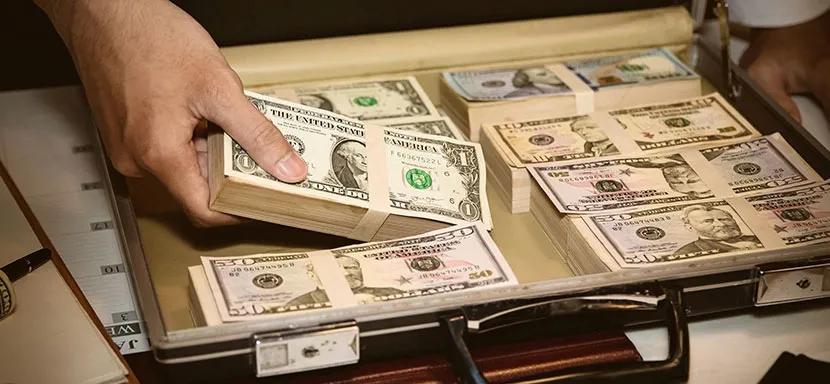
Customs stopped you at the gate and took every dollar you were carrying.
You cannot touch your own money.
Official letters keep arriving with deadlines you do not fully understand.
You are afraid this ends with your cash gone for good, or with your name attached to a federal case.
When things go wrong, our national cash smuggling lawyer is prepared to help.
Jeffrey S. Weiner, P.A. is admitted to practice before seven federal circuit courts of appeals and the United States Supreme Court, and our federal forfeiture lawyers set aside a final order of forfeiture for several million dollars entered against clients in federal district court. Clients who came to us certain their money was gone have gotten it back, with no conviction attached to their name.
Contact us today and tell us what happened at the airport. We can help you understand what the government has to prove, and what it could take to get your money back.
Prior results do not guarantee similar outcomes.
We defend clients across the country in every stage of a federal cash reporting case, from the moment Customs and Border Protection stops you at the gate through a federal indictment years later. Whether your cash was seized last week or you are already facing federal charges, our federal cash smuggling practice covers:
Whatever stage your case is at, from a seizure notice sitting on your kitchen table to an indictment naming you as a defendant, our national cash smuggling defense attorney steps in immediately and starts working to get your money and your record back.
Our attorneys have tried cases in more than 25 states and argued before the Florida Supreme Court and the United States Supreme Court. Wherever your case stands right now, we've likely stood there before — with a client's freedom on the line.
Call Us Today 305-670-9919
Two federal laws drive almost every cash smuggling case. 31 U.S.C. § 5316 requires anyone carrying more than $10,000 in currency or monetary instruments into or out of the United States to report it on FinCEN Form 105, commonly called a CMIR. Miss that filing, even by accident, and Customs and Border Protection can seize every dollar on the spot.
31 U.S.C. § 5332 goes further. If the government can show you concealed the cash specifically to dodge that reporting requirement, you are facing bulk cash smuggling charges carrying up to 5 years in federal prison, plus forfeiture of the entire amount involved and any property connected to it, not just the cash itself. Neither law requires proof that the money came from a crime. Both turn on what you did at the border, not on where the money came from.
This reflects federal law as of July 2026.
The government does not need to convict you of anything to keep your money. Civil forfeiture lets Customs and Border Protection hold your cash permanently if you miss a filing deadline or cannot document where it came from fast enough. And if you stay silent for 30 days after a seizure notice, CBP treats that silence as abandonment and moves to forfeit the funds outright.
If federal prosecutors do bring a criminal charge under the bulk cash smuggling law, 31 U.S.C. § 5332, you are facing up to 5 years in federal prison and forfeiture of every dollar connected to the offense, not just the cash in your bag. A seizure can also follow you long after the case closes, through flagged travel records, frozen business accounts, and questions from immigration officers who see a currency violation on your file.
1. We pull the CBP seizure notice, property receipt, and any FinCEN Form 105 on file within days of taking your case, so we know exactly what the government seized and why.
2. We build the paper trail CBP and the Department of Justice will demand, gathering bank records, business ledgers, gift letters, and sale documents that prove where your money legitimately came from.
3. We decide whether to file an administrative petition for remission or wait for judicial forfeiture, a call shaped by more than 50 years arguing federal cases in courts across the country, including before the United States Supreme Court.
4. If your case is referred to a United States Attorney for prosecution or judicial forfeiture, we file your claim and answer within the deadline the law sets, and we start building your defense before the government files a single motion.
5. We negotiate directly with the Assistant United States Attorney assigned to your file, working toward return of your funds, dismissal of the charge, or a resolution that keeps you out of federal prison.
Our federal defense lawyers have set aside a final forfeiture order for several million dollars, kept clients in multimillion-dollar federal financial cases out of prison entirely, and convinced federal prosecutors to close a grand jury investigation without ever filing charges. We have also won reversal of a federal prison sentence on appeal, a result the U.S. Court of Appeals grants only rarely.
| Outcome | Case Type |
| Forfeiture order set aside | Several million dollars, U.S. District Court |
| Probation, zero prison time | Unlicensed money transmission, multimillion dollar federal case |
| No indictment | Federal grand jury investigation, Department of Justice |
| Sentence vacated and remanded | Federal Sentencing Guidelines misapplied, U.S. Court of Appeals |
Prior results do not guarantee a similar outcome. Every case depends on its own facts.
Jeffrey S. Weiner, P.A. is based in Miami, home to Miami International Airport — a high-volume port for Customs and Border Protection currency seizures — and a short drive from the U.S. District Court for the Southern District of Florida. Jeff Weiner has practiced in federal court since 1974, admitted before the Southern District of Florida, seven federal circuit courts of appeals, and the United States Supreme Court, where he personally argued a landmark Fourth Amendment case, Florida v. Jimeno.
That reach means we take cash smuggling and FinCEN Form 105 cases from clients seized at airports nationwide, not only in Miami. Whether your cash was taken at MIA, JFK, LAX, or a land border crossing, the federal seizure process runs the same way regardless of which port stopped you, and we build your case with nationwide federal court experience behind it.
Many of the cash seizure cases we handle involve travelers who are not U.S. citizens, business owners moving family savings between countries, or green card holders visiting relatives abroad. A currency violation raises extra stakes if you are not a citizen, because a federal cash smuggling case can affect an immigration application, a green card renewal, or a naturalization interview years later, even after the forfeiture itself is resolved administratively.
We have represented clients from Latin America, Europe, the Middle East, and Asia in cases that started with a stop at a U.S. port of entry, and we coordinate directly with immigration counsel when a case touches both a forfeiture and a pending immigration matter. If you are traveling on a visa, a green card, or without U.S. citizenship and your cash was seized, tell us that upfront so we can protect both your money and your immigration status from day one.
Serving Criminal Defense Clients for Over 50 Years
You should strongly consider it. You generally have 30 days from the date CBP mails its seizure notice to file a petition or election of proceedings, and CBP treats silence after that window as abandonment of your own money. The sooner we see the notice, the more options you have.
FinCEN Form 105, also called a CMIR, is required any time you carry more than $10,000 in currency or monetary instruments into or out of the United States. It applies to U.S. and foreign travelers alike, and the threshold covers cash split among family members traveling together.
Yes. Civil forfeiture lets the government keep seized currency without a criminal conviction, and in many cash smuggling cases no charges are ever filed. That is exactly why contesting the civil forfeiture on its own terms matters, whether or not a prosecutor gets involved.
You can file a petition for remission asking CBP to return the money administratively, or file a claim that forces the government to prove its case in federal court. Which path makes sense depends on how strong CBP’s evidence is and how quickly you can document where the cash came from.
It is a federal charge under 31 U.S.C. § 5332, prosecuted by a United States Attorney’s Office, not by a state prosecutor. That means your case is handled in federal court, under federal sentencing rules, from the day it is filed.
Yes, if you failed to report it or the government believes you concealed it to avoid reporting. The forfeiture law does not require the money to be connected to any other crime, which is why documenting a lawful source is central to getting it back.
Yes. We represent clients whose cash was seized at airports and border crossings across the country, not only at Miami International Airport, and federal cash reporting law applies the same way regardless of which port stopped you.
Cost depends on whether your case stays in the administrative petition process or moves into federal court litigation. We walk you through the realistic cost of each path during your first conversation with us, so you know what you are deciding before you decide it.
Civil forfeiture targets the money itself and does not require charging you with a crime, while criminal forfeiture is a penalty imposed after a conviction under a law like 31 U.S.C. § 5332. Many cash smuggling cases involve civil forfeiture alone, with no criminal charge ever filed against the traveler.
You do not have to figure out a CBP seizure notice or a federal cash smuggling charge on your own. Jeffrey S. Weiner, P.A. has set aside a multimillion dollar federal forfeiture order, kept clients in major federal financial cases out of prison, and argued before the United States Supreme Court. Contact us today, tell us what happened at the border, and let us start building the record that gets your money and your name back.
You may call our office 24 hours a day, 7 days a week. We are always ready to consult with you, whether
by telephone consultation, a meeting in our office, or a visit if you are incarcerated. All communications
are confidential and protected by the attorney-client privilege.
“*“Indicates Required Fields
"*" indicates required fields
Two Datran Center, Suite 1910
9130 South Dadeland Boulevard
Miami, FL 33156

Copyright © 2026 Jeffrey S. Weiner, P.A. All Rights Reserved. Disclaimer | Site Map | Privacy Policy.
*Images are obtained under license from Canva and other third-party stock image providers, with attribution included where required.
Digital Marketing By: 
