
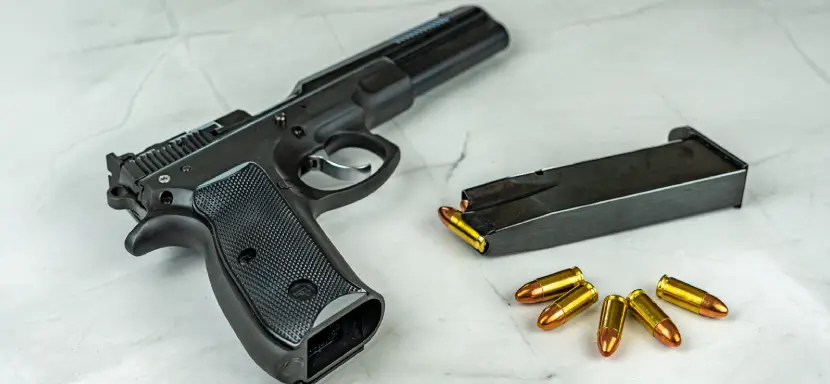
The use of a firearm during the commission of a crime elevates the seriousness of the underlying crime and often forms the basis for additional charges in both state and federal courts. If you are in this situation, you should hire a Miami gun crime lawyer. Your gun crime lawyer should be knowledgeable in all aspects of firearms. Experience as a criminal defense attorney is not enough to ensure excellent representation since knowledge of firearms is often essential in defending a person charged with a federal or state firearm offense.
Our founding attorney, Jeffrey S. Weiner, has trained extensively with Massad Ayoob (Director of the Lethal Force Institute), John Farnam (Defense Training Institute), and other top firearms and self-defense experts for many years. He is certified in handgun retention and disarming techniques, and has competed in firearms competitions. He has lectured throughout the United States on defending persons charged with firearms crimes, including first-degree murder, second-degree murder, manslaughter, aggravated battery, aggravated assault, and for all types of violations of federal laws involving firearms, including but not limited to the sale or transfer of firearms. He has also handled cases and lectured to fellow criminal defense attorneys on weapons topics including self-defense, stand your ground, drawing a weapon, and carrying a concealed firearm, just to name a few.
From his more than 50 years of experience, Attorney Weiner is convinced that knowledge of firearms (including handguns and long guns), shooting techniques, and the handling of weapons has proven vital in defending our clients in firearms-related cases.
Our attorneys have tried cases in more than 25 states and argued before the Florida Supreme Court and the United States Supreme Court. Wherever your case stands right now, we've likely stood there before — with a client's freedom on the line.
Call Us Today 305-670-9919
Defending a criminal case is an extremely great responsibility for a criminal defense attorney. Without a working knowledge of firearms and other weapons, learned over years of experience with guns, edged weapons, and other items used for self-defense, providing the best defense for a person charged with a firearms defense is much more difficult. If you are so charged, it is unquestioningly in your best interest to hire a Miami gun crime lawyer who is knowledgeable in these types of cases. Firearms cases are extremely difficult and often carry mandatory minimum periods of incarceration.
Our attorneys can help you if you have been charged with a state or federal firearms crime. Do not make statements to law enforcement, even if you are absolutely convinced that your use of the firearm or other weapon was justified. You can contact our law firm anytime to schedule a meeting.
It is a federal, and often a state, offense for a felon to possess a firearm or even to possess ammunition. The mere act of possession is the crime; ownership is not necessary. If you have ever been convicted of a felony – or pled guilty to a felony and the court entered a judgment of guilt – you are generally considered a convicted felon by the federal government. If you fall into that category, you may not possess a firearm or bullets.
Many gun magazines feature discussions of the United States Supreme Court case of District of Columbia v. Heller, in which the Supreme Court held that the Second Amendment protects the right to possess a firearm in the home for self-defense. Most courts have held that this Second Amendment right, as applied by the Supreme Court, does not apply to convicted felons.
In Florida, a plea of no contest (also called “nolo contendere”) with a “withhold of adjudication” does not count as a prior conviction under Florida law. That means you cannot be properly charged with the felony of “possession of a firearm by a convicted felon” based on that case.
The same is true when a person pleads guilty in a Florida court and the judge withholds adjudication. In Clarke v. United States (Fla. 2016), the Florida Supreme Court held that this kind of plea is not a conviction under Florida’s felon-in-possession law, and the Eleventh Circuit then applied that rule to federal charges under 18 U.S.C. § 922(g)(1). A withhold may still count in some other settings, such as certain federal sentencing rules.
Florida is one of several states that allow their citizens the opportunity to take responsibility in a criminal case and resolve the case by pleading guilty or no contest and receiving a withhold of adjudication. This opportunity may be provided to non-violent or first-time offenders. In federal court, if you are found guilty, then you are “guilty.” There is no such thing as a withhold of adjudication of guilt upon conviction of a federal felony.
Federal prosecutors charge felon in possession cases under 18 U.S.C. § 922(g). Section 922(g)(1) makes it a crime for a person with a prior felony conviction to have a gun or ammunition. In most cases, the law looks at the most time the old crime could carry, not the time you actually served. Section 922(g) also covers other groups, such as some people under certain protection orders or convicted of misdemeanor domestic violence.
In Miami, federal gun cases are brought by the U.S. Attorney’s Office for the Southern District of Florida and heard at the Wilkie D. Ferguson, Jr. United States Courthouse at 400 North Miami Avenue. State charges under Fla. Stat. § 790.23 are filed by the Miami-Dade State Attorney’s Office.
In a federal case, prosecutors must prove each of these points beyond a reasonable doubt:
Since Rehaif v. United States (2019), the government must also prove you knew you had that kind of prior conviction when you had the gun. Possession can be actual, such as a gun on your body, or constructive, such as a gun in a car or room you control. These cases often turn on who else had access to the gun.
The maximum prison term under 18 U.S.C. § 924(a)(8) is 15 years. If you have three earlier convictions for violent felonies or serious drug offenses, the Armed Career Criminal Act in 18 U.S.C. § 924(e) requires at least 15 years. The U.S. Sentencing Commission reports that in fiscal year 2025, people sentenced under section 922(g) received an average of 72 months, and 98% went to prison. Those numbers cover all section 922(g) cases, which most commonly involve a prior felony. Cases sentenced under the Armed Career Criminal Act averaged 192 months.
Florida’s law is also serious. Under Fla. Stat. § 790.23, felon in possession is a second-degree felony with up to 15 years in prison. A three-year minimum prison term can apply when the State proves actual possession under Florida’s 10-20-Life law.
Every case is different, and results depend on the facts. Defenses we look at can include:
Florida’s felon-in-possession law does not apply to a person whose civil rights and firearm authority have been restored. Federal law is separate. In August 2026, the Justice Department published a final rule that revives the federal relief process in 18 U.S.C. § 925(c). The rule took effect on September 21, 2026, and the Department is opening applications in stages.
Federal relief covers only the federal ban and does not remove Florida’s ban. Applying does not make it legal to have a gun before relief is granted.
If you have been charged, or think you are under investigation, speak with our team before you talk to investigators. Call 305-670-9919 or contact us online.
It is a crime for a person with a prior felony conviction to have a gun or ammunition. It can be charged under federal law (18 U.S.C. § 922(g)(1)) or Florida law (Fla. Stat. § 790.23).
It is a second-degree felony with up to 15 years in prison. A three-year minimum can apply when the State proves actual possession.
Yes. Section 922(g)(1) applies even if you never used the gun to hurt anyone.
Yes, under constructive possession, which means you knew about the gun and could control it. Prosecutors must still prove both knowledge and control.
In most cases, no. The Florida Supreme Court held in Clarke v. United States (2016) that a guilty plea with adjudication withheld is not a conviction under Florida’s law, though it may still count for some sentencing purposes.
So far, yes in Florida. The Eleventh Circuit upheld section 922(g)(1) in United States v. Dubois (2025), although courts in some other circuits have allowed certain challenges.
Possibly, but state and federal law each have their own steps. DOJ’s new federal relief process covers only the federal ban, so Florida restoration is separate.
A gun crime lawyer reviews how police found the gun, challenges illegal searches, tests the possession and knowledge issues, and deals with state or federal prosecutors.
Yes, it can happen, because the state and federal governments can each bring their own case. Which court handles it depends on the facts and the prosecutors’ decisions.
Say nothing about the gun, ask for a lawyer, and call a criminal defense attorney right away. Statements to police can be used against you in both state and federal court.
They say a good attorney knows the law and a great attorney knows the judge but Jeff Weiner is in a league of his own. A passionate, compassionate, and consummate professional, I’ve never needed (or wanted) to use anyone else when dealing with legal matters for myself, my friends, and…
– Jonathan P.
Yisel Villar is top notch! She is the best and extremely knowledgeable. If you need a criminal attorney do not look anywhere else!
– Steven S.
Best defense in the state. Always there when needed. Thank you for always being there through rough times. I would recommend Jeff and his team to anyone in a legal/criminal situation.
– Anthony J.
I highly recommend Jeff Weiner and co. I felt I was a family member talking to my kin. Yisel and Jeff made things happen!
– Dan C.
Incredible attention and availability to client, with quick desired result!
– Sarah
You may call our office 24 hours a day, 7 days a week. We are always ready to consult with you, whether by telephone consultation, a meeting in our office, or a visit if you are incarcerated. Communications with our firm are generally confidential and protected by the attorney-client privilege.
You may call our office 24 hours a day, 7 days a week. We are always ready to consult with you, whether
by telephone consultation, a meeting in our office, or a visit if you are incarcerated. All communications
are confidential and protected by the attorney-client privilege.
“*“Indicates Required Fields
"*" indicates required fields
Two Datran Center, Suite 1910
9130 South Dadeland Boulevard
Miami, FL 33156

Copyright © 2026 Jeffrey S. Weiner, P.A. All Rights Reserved. Disclaimer | Site Map | Privacy Policy.
*Images are obtained under license from Canva and other third-party stock image providers, with attribution included where required.
Digital Marketing By: 
