
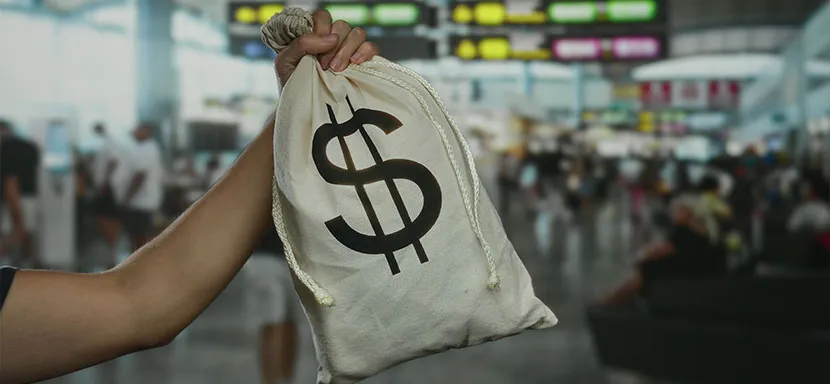
You went through security at Miami International Airport (MIA), and instead of boarding your flight, you were pulled into a small room and asked how much cash you were carrying. Now the cash is gone, and you are holding a letter full of statute numbers and a deadline you do not fully understand.
You did not smuggle drugs. You did not launder anyone’s money. You just did not know you had to declare it, and now the government is treating your savings like evidence in someone else’s case.
Jeffrey S. Weiner personally argued the United States Supreme Court’s leading case on searches and consent, Florida v. Jimeno, and his firm has already gone into federal court and undone a forfeiture order worth several million dollars for clients standing in your exact position.
Contact our Miami airport cash seizure lawyer before your response window closes.
Jeffrey S. Weiner holds Martindale-Hubbell’s AV Preeminent rating, the highest mark for both skill and ethics. He also carries verified client reviews on Avvo and has received the National Association of Criminal Defense Lawyers’ Robert C. Heeney Award.
Our attorneys have tried cases in more than 25 states and argued before the Florida Supreme Court and the United States Supreme Court. Wherever your case stands right now, we've likely stood there before — with a client's freedom on the line.
Call Us Today 305-670-9919
We represent travelers, business owners, and foreign nationals whose cash or property was seized at Miami International Airport or by federal agents anywhere in South Florida. Whether your money was pulled at a TSA checkpoint, a gate, or a secondary inspection room, our federal forfeiture practice covers:
Our experience encompasses these scenarios and more, providing you with a dedicated legal advocate regardless of the specific circumstances surrounding your seizure.
Here is the number that matters most right now: 35 days. By law, CBP must give you at least 35 days from the date it mails your Notice of Seizure to file a claim demanding your money back. Some notices allow more time, so always check the exact date printed on your own letter — that date, not this page, controls your deadline. Miss it, and the government keeps the money through an informal process, with no judge and no hearing.
CBP treats your silence as consent, the seizure becomes final, and the money is gone for good, distributed to federal law enforcement programs instead of returned to you.
A petition for remission or mitigation asks the government to be lenient. It does not force anyone to prove the seizure was justified, and it can drag on for more than a year while your money sits untouched.
A verified claim for court action does something different. It forces the United States Attorney’s Office to either return your property or file a forfeiture complaint in the Southern District of Florida and prove, with evidence, that your money was connected to a violation.
Time is a critical factor when dealing with a federal seizure, but you do not have to navigate these deadlines alone. Our MIA cash seizure attorneys understand the stress of having your property taken and the complexity of the legal path ahead.
Here is the structured approach we take to secure your interests and guide you through each stage of the process:
Step 1: We review your Notice of Seizure and CBP case file within 24 hours of your call, and we calculate the exact date your response window closes.
Step 2: We file a verified claim for court action instead of a remission or mitigation petition, because a claim forces the government to prove its case or give the money back. A petition asks CBP for leniency on its own timeline, and you often must file it within 30 days of your notice, a shorter window than the 35-day claim deadline. Filing a claim instead moves your case out of CBP’s hands and into federal court, where a judge decides.
Step 3: We open direct settlement talks with the Assistant United States Attorney in the Civil Division of the Southern District of Florida, often before a forfeiture complaint is ever filed.
Step 4: We assemble the paper trail that proves where your money came from, including bank records, gift letters, invoices, and payroll documents, whatever the source requires.
Step 5: If the government files a judicial forfeiture complaint, we litigate it in the Wilkie D. Ferguson Jr. United States Courthouse with the same preparation our founding attorney brought to the United States Supreme Court. We come ready to try the case, not to settle it away for less than it’s worth.
Every case is different. Contact us to discuss the specifics of your situation and how we may assist.
These are verified results from our firm’s federal practice, not hypothetical outcomes.
We were retained after a final order of forfeiture for several million dollars had already been entered against our clients in Federal District Court, and we successfully had that order set aside.
We were brought in after sentencing, not as trial counsel, and convinced the U.S. Court of Appeals that the District Judge had misapplied the federal sentencing guidelines, sending the case back for a new sentencing hearing.
We convinced a high-ranking federal prosecutor that a sitting member of the United States House of Representatives was innocent of alleged federal election law violations, and the grand jury investigation closed without charges.
Three clients charged with unlicensed money transmission involving millions of dollars in federal court avoided prison entirely and were sentenced to probation.
After a client was sentenced to years in federal prison, we argued on appeal that the District Judge had misapplied the U.S. Sentencing Guidelines, and the U.S. Court of Appeals set the sentence aside and remanded the case for new sentencing.
Prior results do not guarantee a similar outcome.
CBP’s Fines, Penalties and Forfeitures office for Miami International Airport sits in Concourse D of the North Terminal, at 4200 NW 21st Street, just off LeJeune Road and the Dolphin Expressway. Your Notice of Seizure letter comes from that office, and the case number on it ties back to the specific airport encounter itself, not a generic file number.
If a claim moves forward to judicial forfeiture, the case is filed in the Miami Division of the United States District Court for the Southern District of Florida, at the Wilkie D. Ferguson Jr. United States Courthouse, 400 North Miami Avenue in downtown Miami. Both buildings sit inside Miami-Dade County, a few miles apart.
Our Miami cash seizure attorneys appear in that courthouse and before the Assistant United States Attorneys assigned to Miami-Dade County forfeiture matters on a regular basis. Knowing which office is handling your file, the airport’s FP&F desk or the U.S. Attorney downtown, changes how quickly we can move.
Reporting rule: Anyone entering or leaving the United States with more than $10,000 in cash, checks, or other monetary instruments must report it on a currency form before they fly. Failing to do so, even by accident, is what turns a legal amount of cash into property the government can seize and try to keep (31 U.S.C. § 5316).
Claim deadline: Once CBP mails your Notice of Seizure, the law gives you at least 35 days from the date on the letter to file a claim demanding the government either return the property or take the matter to federal court instead of resolving it administratively. Miss it, and the administrative forfeiture becomes final with no further right to challenge it (18 U.S.C. § 983(a)(2)(B)).
Every other statute that could theoretically apply, from structuring to bulk cash smuggling, ultimately funnels back through these two provisions once your case reaches federal court. This reflects federal currency reporting and civil forfeiture law as of July 2026.
Serving Criminal Defense Clients for Over 50 Years
Any amount. There is no limit on how much cash you can travel with into or out of the United States. The law only requires that amounts over $10,000 be reported on a currency form before you fly, and CBP can still seize a smaller amount if it believes the money was deliberately split up to dodge that report.
An officer at the airport takes the currency and is supposed to issue you a receipt on the spot, and CBP’s Fines, Penalties and Forfeitures office in the North Terminal later mails a formal Notice of Seizure with a case number, the statute cited, and your response deadline spelled out.
Yes, you likely need an attorney. Innocence does not return your money automatically, and it never has under this process. The government keeps seized cash unless you take the correct legal step within the deadline, and that step is rarely the one CBP’s letter makes look easiest to choose.
Remission and mitigation ask the government for leniency without a hearing, and CBP decides both on its own paperwork, on its own timeline. A claim for court action forces the United States Attorney’s Office to either return your property or prove its case in federal court in front of a judge.
Often, yes. Immigration status does not eliminate your right to file a claim, though it can raise the stakes if the seizure gets tangled up with a separate immigration matter, and we routinely handle these cases for foreign travelers connecting through MIA on international flights.
That is exactly the kind of story that can strengthen your case. Bank records, gift letters, invoices, and payroll records showing where the money came from carry real weight in front of an Assistant United States Attorney reviewing your claim.
The seizure becomes final once your deadline passes, and the money is distributed to federal law enforcement programs rather than returned to you. There is no appeal, no second letter, and no reminder once that window closes.
No, the opposite. Filing the correct paperwork immediately after we review your file usually moves your case forward faster than waiting on CBP’s own administrative timeline, and it protects your deadline from the moment we are retained.
Contact Jeffrey S. Weiner, P.A. today for a confidential consultation. Attorney Weiner has personally argued search and seizure law before the United States Supreme Court, and his firm has already undone a multimillion-dollar federal forfeiture order for a client who stood exactly where you stand now.
Your response window is running whether you call us or not. Bring the letter CBP sent you, and we will tell you exactly where your deadline falls.
You may call our office 24 hours a day, 7 days a week. We are always ready to consult with you, whether
by telephone consultation, a meeting in our office, or a visit if you are incarcerated. All communications
are confidential and protected by the attorney-client privilege.
“*“Indicates Required Fields
"*" indicates required fields
Two Datran Center, Suite 1910
9130 South Dadeland Boulevard
Miami, FL 33156

Copyright © 2026 Jeffrey S. Weiner, P.A. All Rights Reserved. Disclaimer | Site Map | Privacy Policy.
*Images are obtained under license from Canva and other third-party stock image providers, with attribution included where required.
Digital Marketing By: 
